How to use bill of lading data for better shipment research
Using bill of lading data as shipment research evidence
Bill of lading data is useful when it is treated as shipping-document evidence, not as a finished market conclusion. The practical work is to define the question, isolate the fields that can answer it, and then verify any business decision with sources that confirm company identity, product meaning and route context.
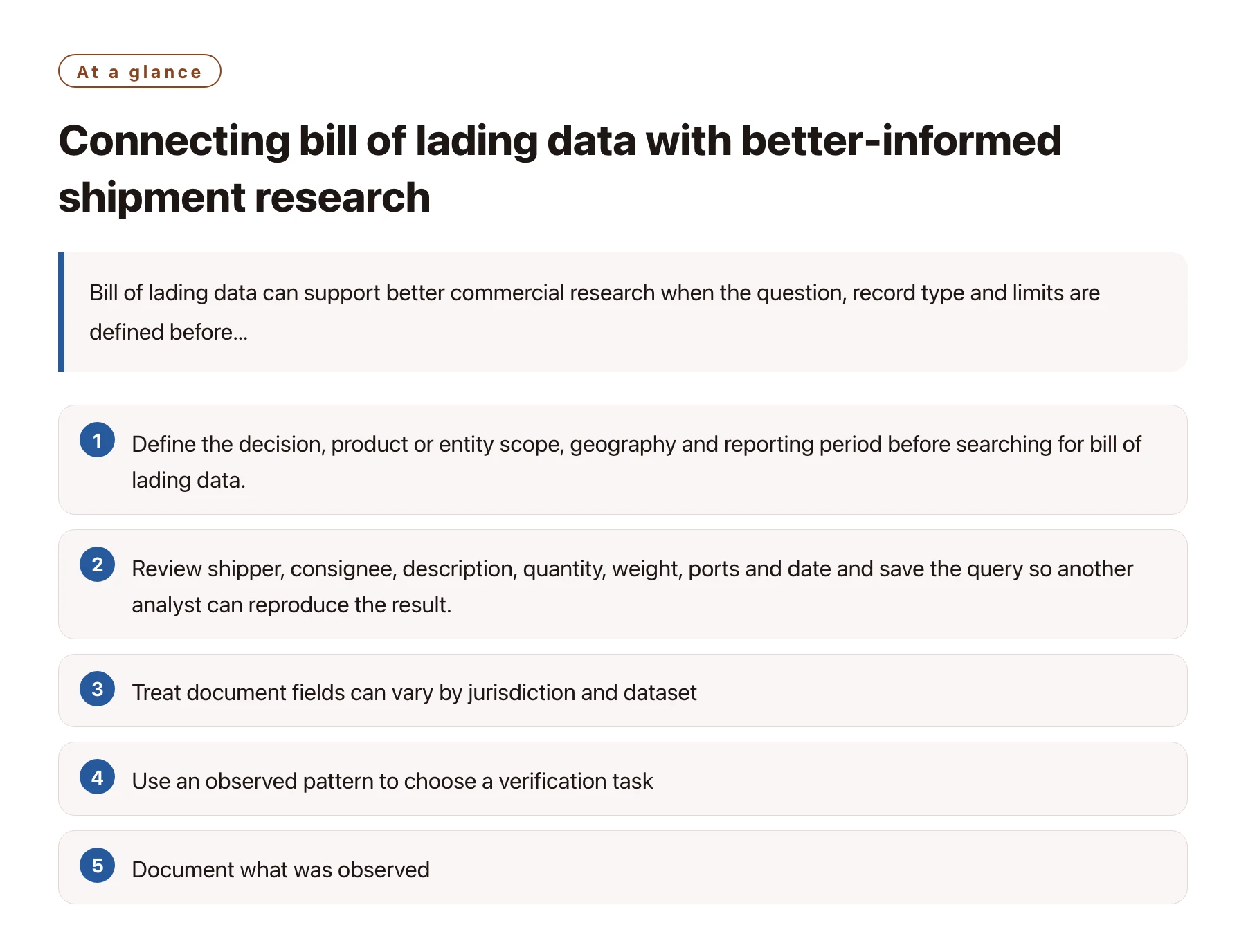
Working rule: use bill of lading records to form a research trail. Do not turn a consignee name, an HS description or a shipment count into a customer list, demand forecast or supplier qualification without follow-up evidence.
1. Start with one research question
Before opening a dataset, write the question in operational terms. “Who imported this product?” is often too broad. A better version is: “Which named parties appear on ocean-shipment records for this product description, from these origins, during this date range, and which records are worth checking against public company information?”
This framing keeps the analysis honest. A bill of lading record can show a reported shipment event and fields captured by the source. It does not automatically prove the buyer’s final use, the manufacturer’s role, the contract price, or future demand.
2. Select fields that match the question
Useful fields usually include shipper, consignee or notify party, product description, HS code when available, quantity, weight, origin, destination, ports, carrier, vessel or voyage, and date. The exact field names and coverage depend on the source, so the first step is to read the dataset notes before comparing numbers.
A TradeData.Pro trade intelligence platform or any other trade-data source should be used as a research environment, not as a substitute for verification. Record the query, filters, date range, field definitions and export time so that another reviewer can reproduce the same result.
3. Separate recorded activity from interpretation
Recorded activity means the dataset contains a shipment-like record with certain parties and goods fields. Interpretation begins when you infer that a party is a buyer, distributor, factory, related company or final customer. That inference needs support from company registries, websites, purchase records, customs rulings, sales conversations or other primary information.
The same caution applies to quantity and value fields. Some records may use gross weight, package count, container count or declared value; others may have missing or normalized fields. The WTO technical notes explain that merchandise trade statistics can differ by coverage, trade system and valuation, including differences between general and special trade and between c.i.f. and f.o.b. valuation concepts [1].
4. Build a practical review sheet
| Column | How to use it | What to verify |
|---|---|---|
| Party names | Group obvious variants, then inspect high-frequency names manually. | Legal identity, role in transaction, related-company names. |
| Product description | Cluster similar wording, but keep original wording visible. | Whether descriptions actually refer to the target product. |
| HS code | Use as a filter or clue, not as the only proof of product scope. | Destination tariff, product specification and possible misclassification. |
| Dates and routes | Look for repeated patterns rather than a single shipment. | Seasonality, route changes, missing ports and reporting lag. |
| Quantity or weight | Normalize units before comparing records. | Unit meaning, duplicates, partial shipments and outliers. |
5. Turn the result into a testable next step
The output should be a short list of hypotheses, not a claim that the data has already proven the market. For example: “These five companies repeatedly appear with matching product descriptions and routes; check whether they are active importers, distributors or unrelated intermediaries.” That next step can guide outreach, competitor research, sourcing checks or compliance review.
If a result affects pricing, supplier qualification, regulatory strategy or customer targeting, corroborate it outside the bill of lading dataset. Search the company’s public filings, product pages, import permissions where available, trade-show records and direct commercial evidence.
6. Preserve a reproducible review
Keep the query, date range, filters, source name, export timestamp, excluded terms and manual corrections. When two sources disagree, do not average them blindly. Compare coverage, update cadence, transport mode, country availability, deduplication and valuation basis first.
World Trade Organization: Technical Notes on Merchandise Trade Statistics explains coverage, trade-system and valuation concepts that can change how trade figures are interpreted. Use those concepts to frame limitations in the review; they do not certify any specific platform’s completeness.
Frequently asked questions
Can bill of lading data prove future demand?
No. It can reveal recorded shipping activity within a source’s coverage. Forecasting demand still requires customer research, pricing data, channel checks and current market context.
Does a consignee field prove the final buyer?
No. The named party may be an importer, forwarder, distributor, related entity or data-normalized name. Treat it as a lead for verification.
Why do two sources show different totals?
Coverage, reporting lag, transport mode, country access, duplicate handling, product classification and valuation rules can all differ. The difference is a research question, not automatically an error.